

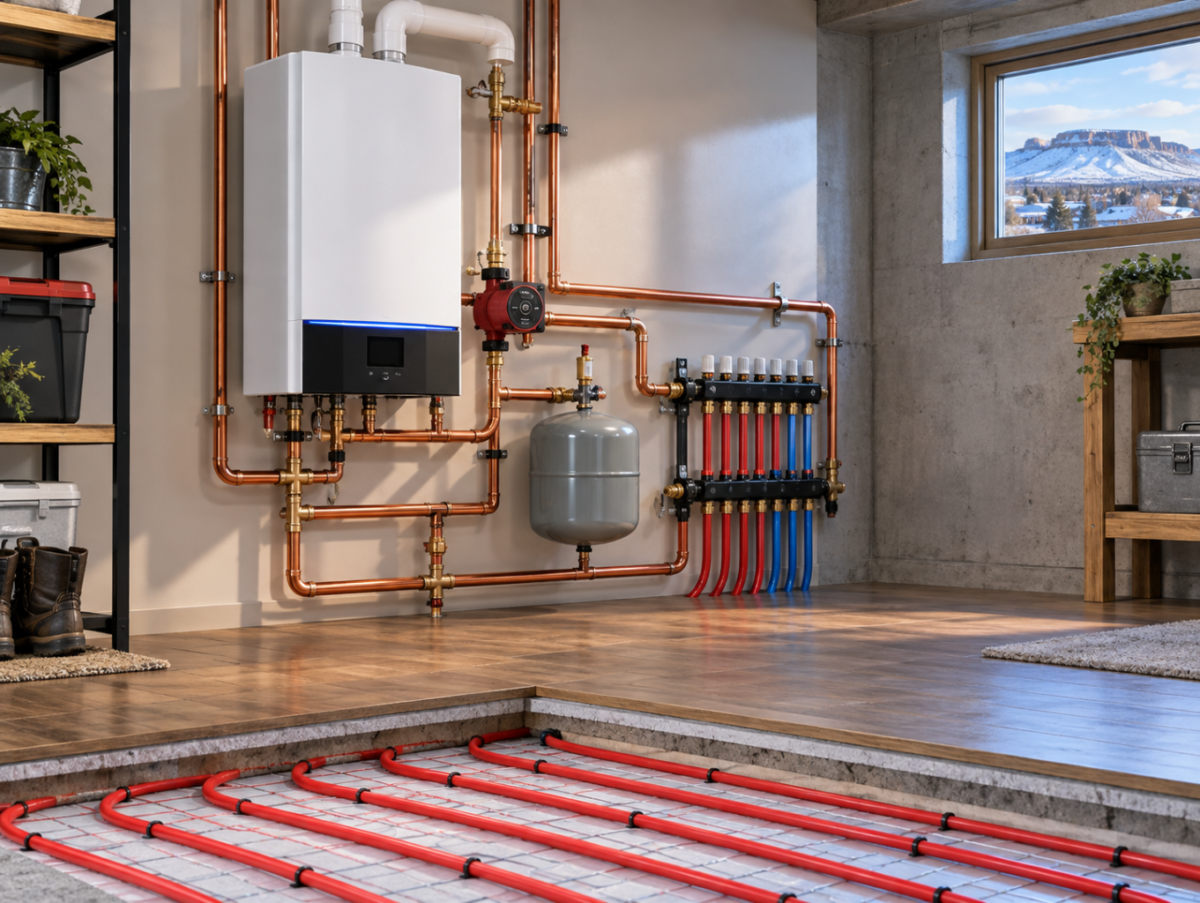
If you get heat from a boiler, baseboard radiators, or warm floors, your heating system works differently from the forced-air furnaces found in many Montana homes. Instead of heated air and moving through ductwork, most residential boiler systems heat water and circulate it through piping to deliver warmth throughout the house. That basic idea is called hydronic heating, and once you understand a few terms, these systems become much less mysterious.
Boiler and radiant heating systems can be especially comfortable during a Great Falls winter because they provide steady, quiet heat without relying on large volumes of moving air. They can also be divided into separate heating zones, allowing different parts of a home to maintain different temperatures.
Table of Contents
What Is a Boiler?
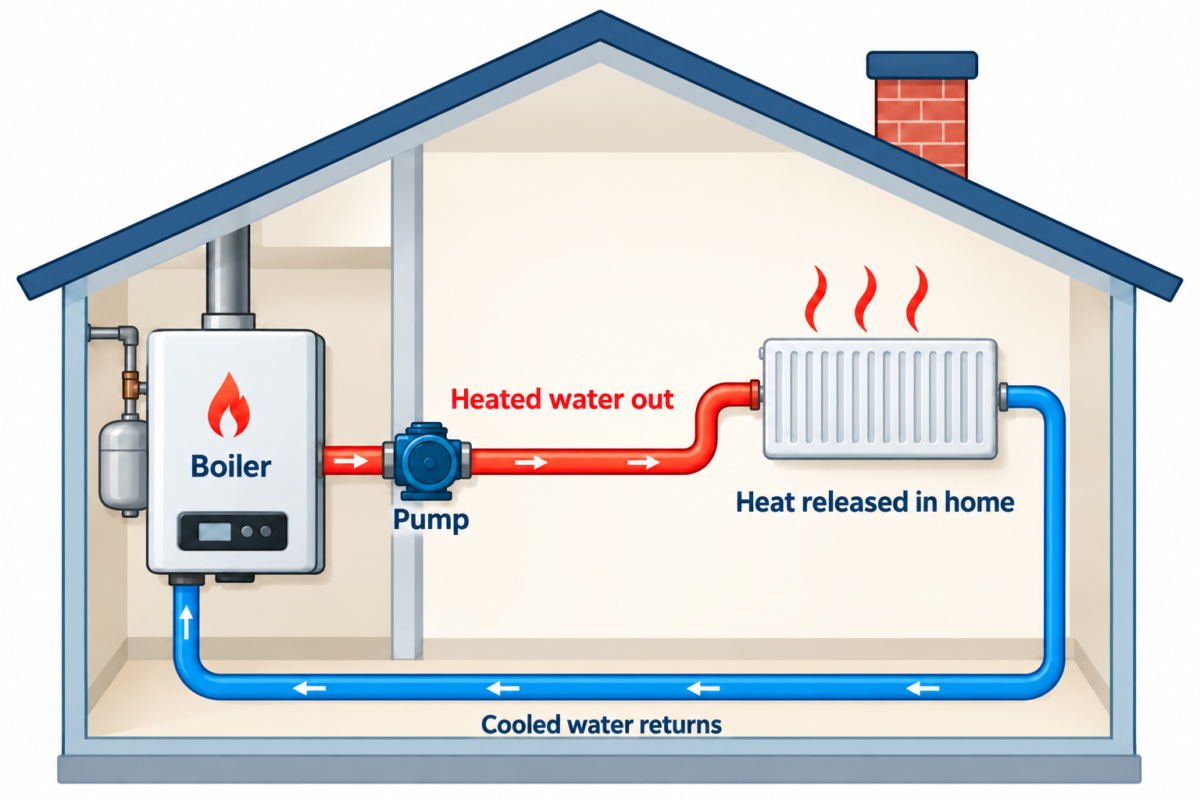
Despite the name, most modern residential hot-water boilers do not actually boil the water. The boiler heats water, and pumps circulate that heated water through the home. After the water gives up some of its heat, it returns to the boiler and is heated again.
That is the biggest difference between a boiler and a furnace. A furnace heats air and pushes it through ducts. A boiler generally heats water and sends it through pipes. The both are considered central heating systems because the heat is produced in one location and distributed throughout the home.
Depending on the system, a boiler may use natural gas, propane, oil, or electricity as fuel. In our area, you may encounter everything from older cast-iron boilers serving baseboard radiators to newer high-efficiency boilers connected to several radiant floor zones.
What Does “Radiant Heat” Mean?
Radiant heating simply means that warm surfaces transfer heat to the people and objects around them rather than relying primarily on moving warm air.
A common example is radiant floor heat. Tubing is installed underneath or within the floor, and warm water circulates through it. The floor becomes a large, low-temperature heating surface, so instead of feeling a blast of warm air followed by a cooling period, the room often feels like it maintains a more stable temperature.
Radiant tubing can be installed in concrete slabs or in floor assemblies above a basement, crawlspace, or lower level. Boiler systems can also supply traditional radiators and hot-water baseboards, so having a boiler does not necessarily mean your home has heated floors.
Basic Boiler Terms Homeowners Should Know
You don’t need to understand every valve and fitting in the mechanical room, but knowing a few common terms makes it easier to describe a problem when you call for service.
Boiler: The equipment that heats the water used by the heating system.
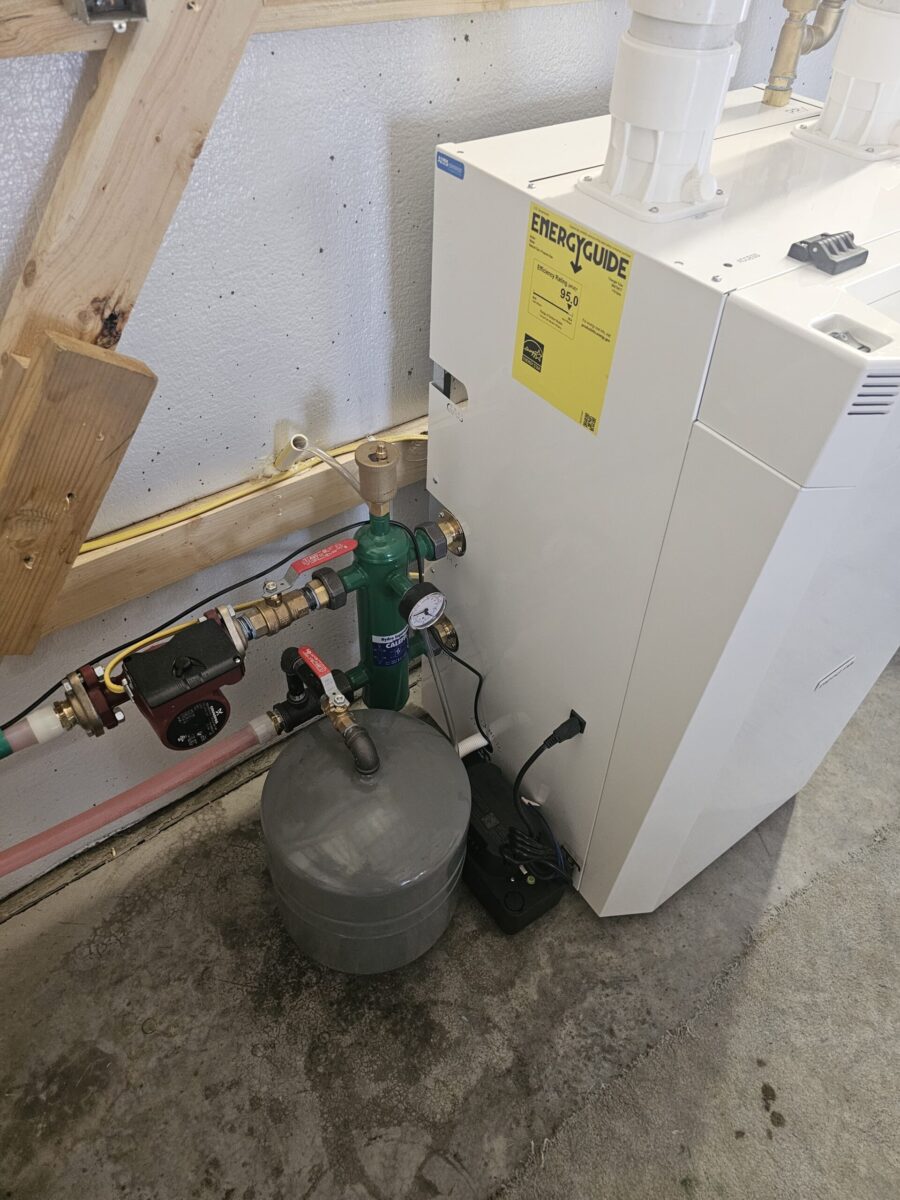
Circulator pump: A small pump that moves heated water through the piping. A house with multiple heating zones may have several circulators.
Zone: A separately controlled portion of the heating system. For example, the basement might be one zone, the main floor another, and a garage radiant floor a third.
Zone valve: A valve that opens and closes automatically to direct water into a particular heating zone.
Thermostat: The control that tells a zone when heat is needed. In a multi-zone system, you may have several thermostats.
Manifold: A distribution point where one larger supply of water is divided among several smaller radiant tubing loops.
Expansion tank: A tank that gives heated water room to expand as its temperature rises. It is an important part of controlling system pressure.
Supply and return: The supply piping carries heated water away from the boiler. The return piping brings cooler water back so it can be reheated.
Learning these terms does not mean homeowners should start adjusting valves or changing boiler settings themselves. Boiler systems are designed around specific water temperatures, pressures, flow rates, combustion settings, and safety controls.
Radiant Heat Is Comfortable, but It Responds Differently
One of the first things homeowners notice about radiant floor heat is that it can react more slowly than forced air. This is especially true when tubing is embedded in a concrete slab.
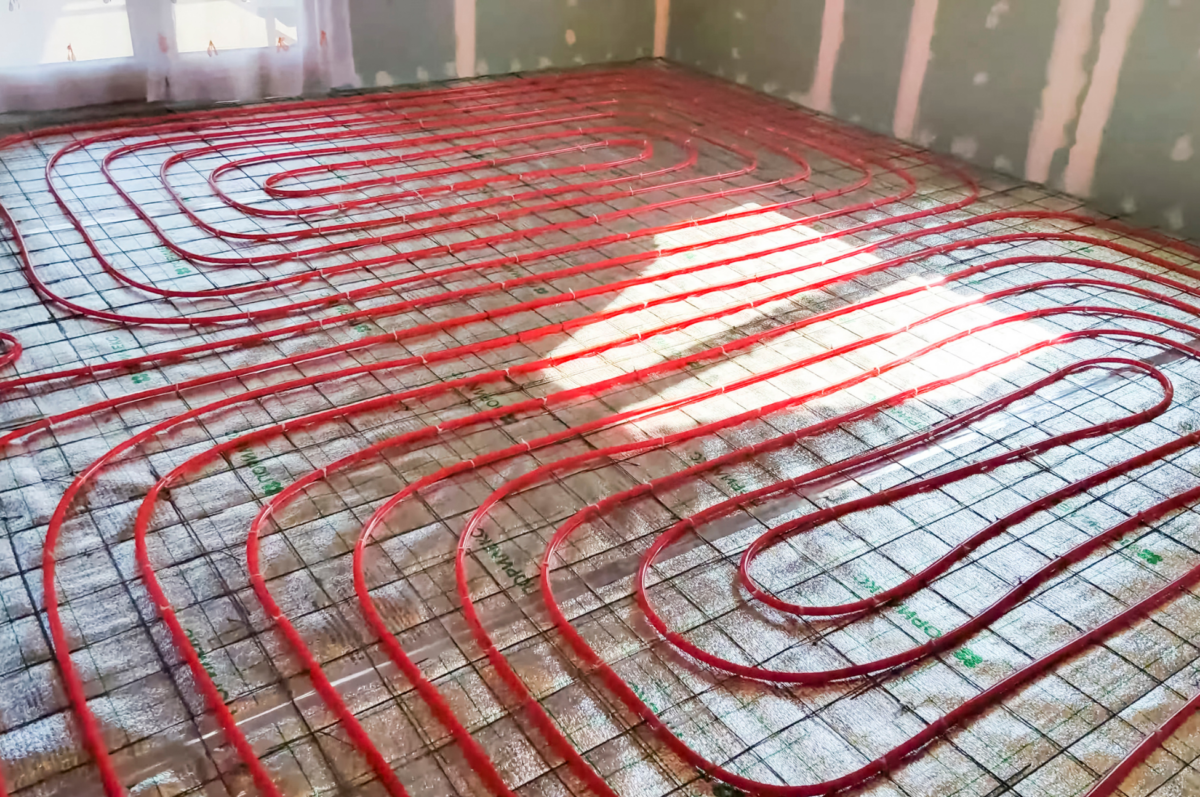
Think of the slab as a large thermal battery. It takes time to warm several inches of concrete, but once warm, that mass continues releasing heat for quite a while. Turning the thermostat up several degrees will not necessarily make the room warm faster.
This becomes important during Montana’s fall and winter temperature swings. A sunny afternoon followed by a sharp overnight drop can sometimes make a high-mass radiant system feel slightly behind the weather. Large thermostat changes may also take much longer than homeowners expect, and radiant heat works best if you can anticipate the need.
What Routine Care Does a Boiler System Need?
A boiler doesn’t usually have the familiar disposable air filter that a forced-air furnace has, but that doesn’t mean it is maintenance-free. Boilers have pumps, controls, valves, burners, venting components, safety devices, and water-side components that need to operate together correctly.
ENERGY STAR recommends annual pre-season professional maintenance for heating equipment, preferably before winter demand becomes heavy. Maintenance commonly includes checking system controls, electrical components, combustion equipment, fuel connections, and safe equipment operation.
For homeowners, some of the most useful routine care is simply paying attention. Keep the boiler area accessible and free of clutter, periodically look around exposed piping for signs of water, and notice changes in how the system sounds or heats the home.

Don’t assume that regularly adding water to a boiler is normal. A closed hydronic system should generally retain its water. If you repeatedly have to add water or notice persistent pressure changes, there may be a leak or another problem that deserves diagnosis.
Signs Your Boiler or Radiant System Needs Attention
Boiler problems don’t always show up as a complete loss of heat. Sometimes the first symptom is one room that suddenly stays cooler than the rest, a circulator that becomes unusually noisy, or a floor zone that takes much longer than it used to.
Other reasons to schedule service include:
- water around the boiler or piping
- frequent pressure changes
- unusual banging or gurgling
- repeated starts and stops
- thermostat calling for heat without the corresponding zone warming up, or
- noticeably higher heating bills without a clear change in weather or thermostat settings.
With combustion equipment, safety deserves extra attention. If you smell gas, leave the building and follow your gas utility’s emergency instructions. Carbon monoxide alarms should also be installed and maintained according to their manufacturer’s instructions.
Boiler Efficiency: What Does AFUE Mean?
If you start researching replacement boilers, you will probably see the abbreviation AFUE, or Annual Fuel Utilization Efficiency. It is a standardized measurement of how efficiently heating equipment converts fuel into usable heat over a typical heating season.
ENERGY STAR currently requires certified residential gas boilers to have an AFUE of at least 90 percent and oil boilers to have an AFUE of at least 87 percent.
Efficiency is only one part of a good boiler installation, though. The boiler also needs to be properly sized, piped, vented, controlled, and matched to the temperatures required by the home’s heating system. A larger boiler is not automatically better.
Boilers Make Sense as a Complete System
One of the most useful ways to think about boiler heat is to stop looking at the boiler by itself. The boiler creates the heat, but the pumps move it, valves direct it, piping carries it, emitters (like a radiator) transfer it into the home, and thermostats tell everything when to operate.
That is why boiler troubleshooting sometimes goes beyond the appliance hanging on the wall. A boiler may be operating normally while the actual problem is a circulator, zone valve, thermostat, air trapped in the piping, or an issue with the radiant loop itself.
For homeowners, you don’t need to diagnose all of that. You simply need to know what normal looks and sounds like in your home and recognize when something has changed.
Questions About Boiler or Radiant Heat?
Boilers and radiant systems can look complicated when you first see all the piping, pumps, and controls, but the basic principle is straightforward: heat the water, move heated water, transfer that heat into the home, and return the water to start the process over.
If you have a boiler or radiant heating system in Great Falls or the surrounding central Montana area and are unsure how it works, whether it needs maintenance, or why one area is not heating correctly, Halcro Heating and Cooling can help. We service heating systems throughout our roughly 100-mile service radius and are happy to explain what we find in easy to understand terms.
For more information about our services, explore our website. You may also find our homeowner guidance helpful when preparing for winter.
For additional information about residential boiler efficiency, ENERGY STAR provides independent boiler efficiency guidance and current certification requirements.